|
Overlooking
Keno |
If
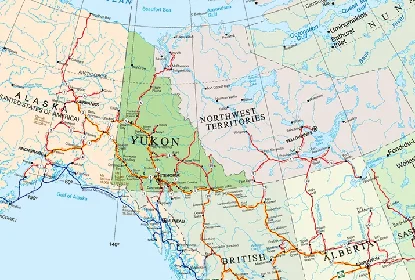
there is one thing that typifies Silver Trail area,
it is accessibility. Nowhere else can the traveler
find such easy access to a mountain top experience
or to the human history of an era.
Much
like the wilderness itself, the Silver Trail history,
which predates the Klondike Gold Rush, is untamed
and still highly visible. Artifacts, buildings,
equipment and monuments still dot the landscape.
While efforts are being made to catalogue it, Silver
Trail history is not yet confined to books and
memories. Supplemented by tours of the history
Binet House in Mayo and Mining Museum in Keno,
travelers here will acquire a firsthand sense of
that history.
Equally
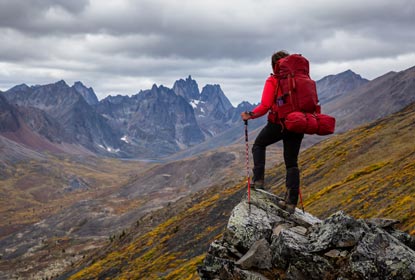
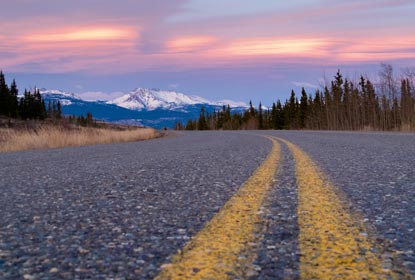
accessible are the area's recreation facilities
and wilderness hikes. Travelers may readily drive
to alpine meadows and hike panoramic ridge tops
by Keno, travel magnificent historic waterways
by canoe, explore old mine sites for unusual specimens,
or fish the area's water.
The
Silver Trail is a quiet, lightly developed region
that will appeal to those who travel with a sense
of adventure.
While
it was the search for gold along the bars of Stewart
River in 1883 that first brought white men in any
number to the region, it was the discovery and
subsequent development of massive silver deposits
that gave the area its name, character and stability.
First
Nations
Before the arrival of fur traders and explorer,
the Stewart had been used by the Northern Tutchone
as part of their traditional area. First Nations
people
camped, hunted and trapped along the river they knew as the Na-Cho Nyäk,
or Big River. More permanent settlements were established around the turn of
the century at McQuestern, Lansing, and at Old Village near Mayo with the development
of trading posts and towns at these locations. All these communities were abandoned
by 1960, with most of the former inhabitants resettling in Mayo.
Early
Mining
In the 1880s, as many as 100 men a year worked
the gravel bars of the Stewart. It came to be
known as the "Grubstake River" because
a man could always find enough gold there to
cover his costs for a season. In 1903, the
town of Mayo was established and the first silver claim was staked on Galena
Creek, near present day Elsa. The property was not mined until 1913, when it
was restaked as the Silver King. A silver staking rush ensued, leading to the
discovery of the Roulette claim in 1919. This claim, on Keno Hill, represented
the most significant silver strike in the Yukon. During the 1920s, Keno Hill
Mines, the town of Keno, and an ore processing mill were all established.
|
|
Pictured
above is Chief Johnson of the Mayo Band,
later called the Nacho Nyäk Dun, 1920.
On
the left is the Silver King claim, circa
1914

|
|
|
Underground
at United Keno Hill Mine, Elsa. |
Gold
panning on Highet Creek |
Silver
Boom
Elsa was developed in 1935, after the mill
was moved to process the rich Elsa claim. United
Keno Hill Mines in Elsa played a major role
in
the Territory's
economy during the silver boom in the 1950s and became the second largest
producer of silver in Canadathe fourth
largest in the world. By the time the low prices
forced its closure in 1989, total production
from the Silver Trail region
was over 213 million ounces of silver, 710 million pounds of lead, and 436
million pounds of zinc.

12,000 tons of silver-lead ore, sacked and
awaiting shipment on Mayo's waterfront, 1938.
It would go by riverboat and barge to Whitehorse,
and from there by train and freighter to smelters
in the U.S.
The
Silver Trail Today
Today, Elsa looks much the same as it did in its heyday, but is essentially
uninhabited. Keno has a small group of residents who maintain the hotel and
mining museum, Mayo remains the area's main service centre, serving an active
placer gold mining industry, mineral exploration companies, wilderness outfitters,
and a growing tourist trade.
You can tour and watch wildlife along our scenic
roads. Or you can camp, boat or canoe/kayak on heritage
rivers. Mountain bike or ride horseback on beautiful
mountain trails through some of the continent’s
wildest country.
Fish, hunt, rock hound, or pan for gold on real
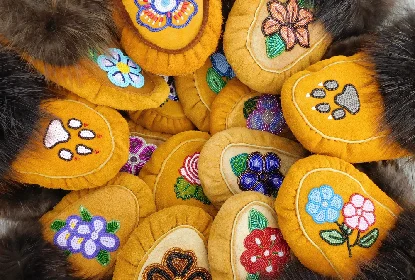
goldbearing creeks. Tour museums and mines. Visit
artists’ studios
for locally-made arts and crafts.
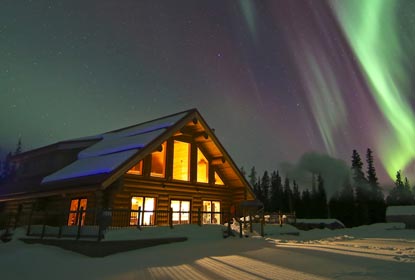
In winter, you can ski, skidoo, or kick back and
watch the Northern Lights while staying at one of
the cozy lodgings in the region.
The Silver Trail’s scenery, flora and fauna
is a photographer’s paradise. Don’t miss
our guided river and air tours, as well as fly-in
fishing and hunting.
Our region is rich in First Nation culture and
pioneer and mining history. The friendly people along
your
route will help you enjoy your stay in the land
of the Nacho Nyak Dun First Nation people, pioneers
such as Jack McQuesten and Al Mayo, and generations
of silver and gold miners.
|