Photo: Earl
Brown
Early in 1897,
American (Lake Tahoe) Frank Watson at the age of 14 left California
and headed north with his father to seek gold in the Klondike. They
worked two claims on Bonanza Creek until sometime after the flood
of 1903 when he headed to the Upper Liard River area. He was the first
white man to travel over land to this area, most traveled on the rivers.
He married Adela Stone and they settled on the shores of Fish Lake,
later to be known as Watson Lake and led a life of a prospector and
trapper. He moved his family a few miles north to Windid Lake as more
people started to settle in the area. He died in 1938 after contracting
pneumonia while in Lower Post. He died in route to Fort Saint John
after being airlifted out on a mail plane. His children and grandchildren
continue to be an intricate part of the Watson Lake community.
Airport construction,
in conjunction with the construction of the Alaska Highway a year
later, signaled the true beginning of the town of Watson Lake. The
community started as an accommodations and supply centre for this
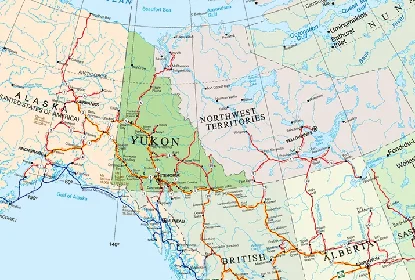
construction. The Alcan Project was a response by the
American Army to the perceived threat of Japan during the Second World
War. It provided an overland supply link between Alaska and the lower
48 states. The original highway, little more than a rough trail of
2,450 km (1,522 miles) from Dawson Creek, B.C., to Delta Jct., Alaska,
then on to Fairbanks, Alaska, was built in the remarkable time of
8 months, 12 days.
A cairn was erected
in 1992 in dedication to the pilots who flew into the Watson Lake
area during the war.
A steam engine
is also on display, which was used in the construction of the airport.
An overnight camping area has been developed for use by itinerant
pilots. The campground has picnic tables, fire pits and firewood supplied
in the tenting area.
Today, the town
of Watson Lake is the key transportation, communication and distribution
centre for mining and logging in the southern Yukon and northern British
Columbia. It is also a major service area for tourism and is the "Yukon's
Gateway."